



How do you work effectively with multiple stakeholders when designing games that tackle complex societal issues?
Our answer is the Integrative Design Process – a collaborative, iterative approach that has proven effective across diverse projects. A short paper describing the process recently earned us the 'Best Poster Award' at the prestigeous GALA Conference 2025.
Why an integrative design approach?
Serious games aim to educate, raise awareness, or inspire social change. These goals demand sensitivity and accuracy, and they require input from diverse voices – domain experts, stakeholders, and the target audience. Traditional frameworks often involve these voices late in development, risking games that feel disconnected or even trivialise important topics. Instead we wanted a process that integrates stakeholders from the very beginning and keeps them engaged throughout.
The process
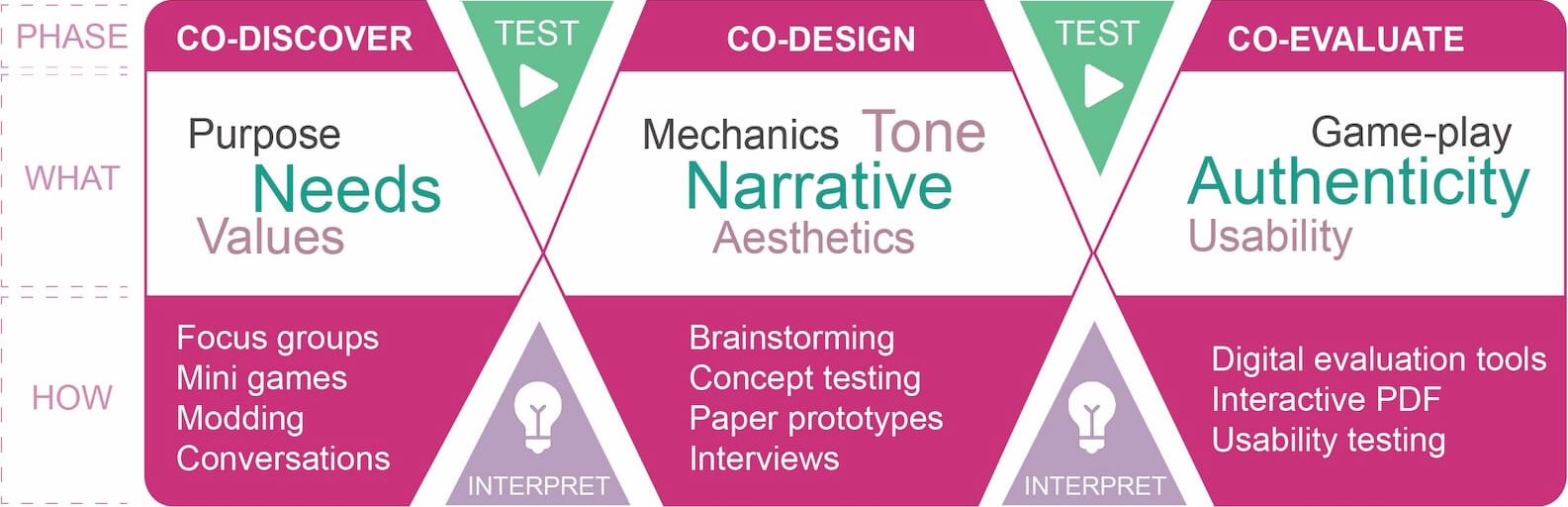
Our process unfolds across three interconnected phases: Co-discovery, Co-design, and Co-evaluation. Each phase is iterative, meaning we revisit ideas as new insights emerge. This flexibility ensures that our games remain aligned with real-world needs and values.

Phase 1: Co-Discovery
This is where everything begins. We bring stakeholders together to define the game’s purpose and uncover the needs and values it should reflect. For example, when creating Built from Beneath, a digital escape room about the city of Bath, UK, we collaborated with five local museums. Each had its own mission and collection, so we held multiple conversations to find common ground. The result? A shared narrative that honoured every institution.
In another project with a youth justice team, we used games as conversation tools. Young people modified tabletop games and played a Storytelling RPG set in a superhero academy – a metaphor that allowed them to express challenges without revealing personal details. These playful methods helped us gather insights that shaped the game’s design brief, the foundation for everything that follows.
Phase 2: Co-Design
Once we know the purpose, we move to shaping the game’s tone, aesthetic, and narrative. For Built from Beneath, we organised a workshop where museum professionals brainstormed stories and artefacts to include. A creative writer helped sequence these into a coherent narrative, supported by site visits and online exchanges of historical materials.
For Immersed in Conservation, a game about deforestation in Malaysia, we worked closely with an expert on rainforest ecology. His insights inspired a unique shopping mechanic where players’ choices affected the health of a virtual forest – making the link between consumer behaviour and environmental impact tangible.
Phase 3: Co-Evaluation
Finally, we validate the game’s authenticity and usability. Stakeholders review prototypes using tools like interactive PDFs or platforms such as Miro. For Built from Beneath, museum professionals annotated storyboards to ensure accurate representation. For T Cell Titans, a game for Great Ormond Street Hospital, young patients playtested early versions and suggested improvements – including adding a final boss for extra excitement!
In conclusion, our Integrative design approach offers a replicable framework for serious games, tackling "wicked problems" like climate change, healthcare, and social inequality by promoting shared understanding among diverse stakeholders. You'll be able to read our short paper about the approach here very soon!


